

Forget John Wayne in John Ford’s westerns or Clint Eastwood in their “spaghetti” versions as seen by Sergio Leone: the most famous cowboy of all is Lucky Luke, period. The hero created by Morris has been dragging his boots and jingling his spurs for so long that he seems to have become immortal. Not to mention that he has left the American West of comics to dominate every possible cultural medium. Not so lonely after all, this “poor lonesome cowboy.”
The New Western
The popularity of the hero born from the imagination of the Franco-Belgian Morris is an exception in the world of comics. You might retort: what about Tintin? Yes, but Tintin hasn’t existed since “Picaros” in 1976. Asterix and Obelix? Of course, but they are less common and, if we disregard the feature films, their new releases are very irregular.
Lucky Luke, for his part, has never stopped shooting faster than his shadow – which now looms over a whole segment of popular culture. With some 80 albums sold, totaling 300 million copies, and a presence on most media that make up the world of entertainment – cinema, television, video games, board games – the cowboy has become a fixture.
Morris’s death in 2001 didn’t stop the cash cow. Endorsed by the master, the cartoonist Achdé took up the mantle, first with Laurent Gerra writing the script ( La Belle Province, published in 2004), then with the duo Daniel Pennac and Tonino Benacquista. With an album released every 18 to 24 months, it’s a jackpot every time. Luke is definitely “lucky.”
Lucky Luke, an iconic character
Known as the cowboy who “shoots faster than his shadow”, gallant, respectful, seductive, and devoid of all fear, Lucky Luke is a kind of knight errant who has made it his goal to defend the widow and the orphan, without letting himself be devoured by the attraction of the smell of gold that drives the pioneers of the American West mad.
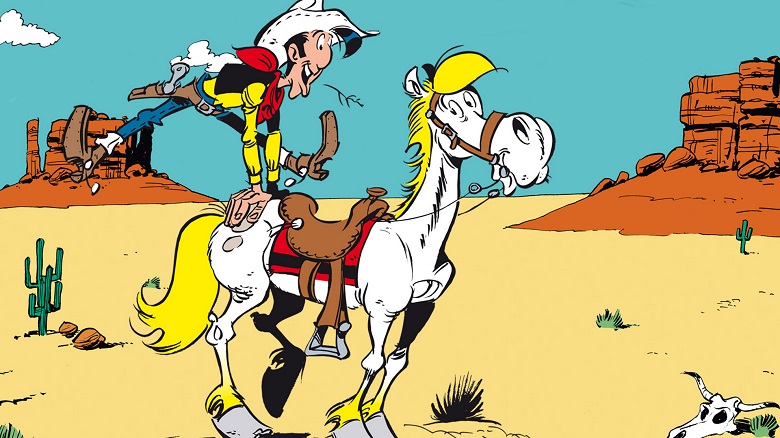
Sporting his signature long black forelock, Lucky Luke is invariably dressed in a yellow shirt, a dark vest, a red scarf, blue trousers, brown boots, and a white hat. These distinctive physical features have made him an iconic character, easy to draw and recognize, and readily adaptable from one medium to another without (too much) damage.
Initially rough and violent, Luke’s character changed with the arrival of René Goscinny as screenwriter: from then on, he no longer killed his enemies but simply disarmed them skillfully; he became a servant of justice and sometimes played his role as a cowboy by leading herds or driving caravans of pioneers, so as not to forget the historical context.
Of course, alongside the hero, other protagonists have made the comic strip famous: Lucky Luke’s horse, Jolly Jumper, who comments on the situation in asides for the reader; the dog Rantanplan, undoubtedly the laziest canine in the world; and the cowboy’s sworn enemies, the 4 Dalton brothers, from the tallest (and most stupid) to the shortest (and most cunning).
Birth and evolution
Lucky Luke was “born” in 1946 in a special edition of Spirou magazine , the 1947 Almanac , created by Morris. Since then, each album has been serialized in a comics magazine: Spirou (1946-1967), Pilote (1967-1973), Le Journal de Lucky Luke (1974-1975), and Le Journal de Tintin (1975-1976). It was later featured in Pif Gadget , and even in Paris Match and VSD .
Initially working alone, Morris was quickly joined by numerous scriptwriters, the most famous of whom was René Goscinny, the creator of Asterix. Arriving on the 9th album (he would remain until the 46th , with the exception of number 10), Goscinny gave Lucky Luke its narrative coherence and transformed the comic strip into a phenomenon.
He inserts anachronisms and cultural references, as well as a few puns (despite Morris’s explicit prohibition). He is also the one who invents the most famous gimmicks of the series: the slogan of “the man who shoots faster than his shadow”, the conclusion of each album with a song against a sunset backdrop, the dog Rantanplan (a parody of Rin Tin Tin).
Tagada, here come the Daltons… and the others
The series is full of historical references that parody characters and events: the Dalton brothers (who existed, yes!), Calamity Jane, Wyatt Earp, Jesse James, Billy the Kid, Abraham Lincoln (who entrusts missions to the hero), the construction of the transcontinental railway, the arrival of the slot machine, the telegraph, the Civil War, etc.
Initially, Morris created his universe from scratch, aiming only to parody westerns, without any serious intent. Things changed after a trip to the United States: the cartoonist altered the angle of his story, not to remove the humor, but to subtly add historical authenticity.
He also enjoys placing many archetypal figures from the Western: the sheriff (discreet, often cowardly), the saloon (poker, fights and cancan), the undertaker (who appears to take measurements before a pistol duel), the banker (and his pocket watch), the telegraph agent, the vultures, etc.
In addition, many personalities have been caricatured throughout the comic strip. Especially actors: Louis de Funès, Jack Palance, Lee Van Cleef, Christopher Lee, Jean Gabin, Kirk Douglas, Sean Connery, Gary Cooper, James Coburn… But also Serge Gainsbourg or Groucho Marx, or even film characters (Norman Bates from Psycho ).
Good Luck!
But Lucky Luke is everywhere, not just in comics. He’s become ingrained in popular culture like a tattoo, impossible to remove. He’s appeared in films, animated features, animated series, numerous video games, and board games. He’s even been made into a figurine and inspired Woody from Toy Story.
In cinema, he materialized in the guise of Terence Hill ( Lucky Luke , 1991) and then Jean Dujardin ( Lucky Luke, 2009), after appearing for a few seconds in Eric and Ramzy’s slapstick comedy, Les Dalton. Fortunately, the four animated feature films have restored the famous cowboy’s reputation, which hadn’t been very successful on the big screen.
But if you look closely, perhaps the most intelligent adaptation is Zemeckis’s western parody, Back to the Future Part III, which incorporates several elements from Leone’s spaghetti westerns, as well as graphic references to Morris’s comic strip with all its clichés of the Wild West. In the French version, Marty even calls his time-traveling car Jolly Jumper!
This cowboy is truly immortal. We’ll certainly be seeing his boots and hearing his spurs around the saloons for a long time to come.