

The narrative arc is the backbone of the story you are going to write. It allows you to build a coherent plot , keep the reader in suspense, place important events at the right time in the narrative , and give your main character and secondary characters an extraordinary destiny.
As an author, it’s important to think about the narrative arc you want to create as soon as you begin writing the story of one of your books. This way, you can write your novel with a clear understanding of its structure , from the beginning of the plot to the final resolution.
What is a narrative arc?
The narrative arc represents the development of the story in your novel. It follows the different episodes of the classic narrative structure : the initial situation, the inciting incident, the rising action, and the resolution. Narrative arcs are used not only for writing books but also for writing screenplays in storyboard form, so you can analyze episodes of your favorite series to try to understand the narrative arcs that make up their stories . For example, screenwriter John Truby develops, page by page, the steps for writing a good screenplay and gives advice and examples for creating a good plot in his book *The Anatomy of Story *, which you can find in our article * Top 10 Books on Novel Writing *. The narrative arc can be represented as a pyramid, called Freytag’s Pyramid . Indeed, the German playwright Gustav Freytag theorized the construction of a plot in seven stages.
The seven stages of the narrative arc
The history exhibition
The first chapters allow for the exposition of the spatio-temporal setting of the plot , introduce the characters and indicate what theme is at the heart of the story.
The trigger for the plot
An incident disrupts the initial situation, putting the heroes into action and launching them into adventure .
The twists and turns of the story
It is a chain of events that constitute the twists and turns of the story and lead it towards the climax of the action.
The high point of history
It is at this point in the plot, the climax , that the reader feels the full force of the adrenaline the characters experience as a result of all these events. The climax is the most important moment in the narrative arc , which is why it must be well-executed and placed at the right time. A climax that occurs too early or too late in the story could shatter the illusion of the novel , something that must be avoided at all costs.
The decline of narrative action
After the climax, the tension gradually subsides , giving the heroes a respite. However, they must still resolve the problem or conflict arising from the events in order to reach a resolution.
The resolution of the plot
The main character manages to overcome the final obstacles . The resolution reveals the consequences that the events had on the characters , how this allowed them to evolve , and their new lives , as we explain in our article How not to (completely) mess up your novel’s ending?
The resolution of the plot
The resolution restored the order that the events had shaken, and the characters’ situation returned to normal .
A concrete example: the narrative arc in The Hunger Games
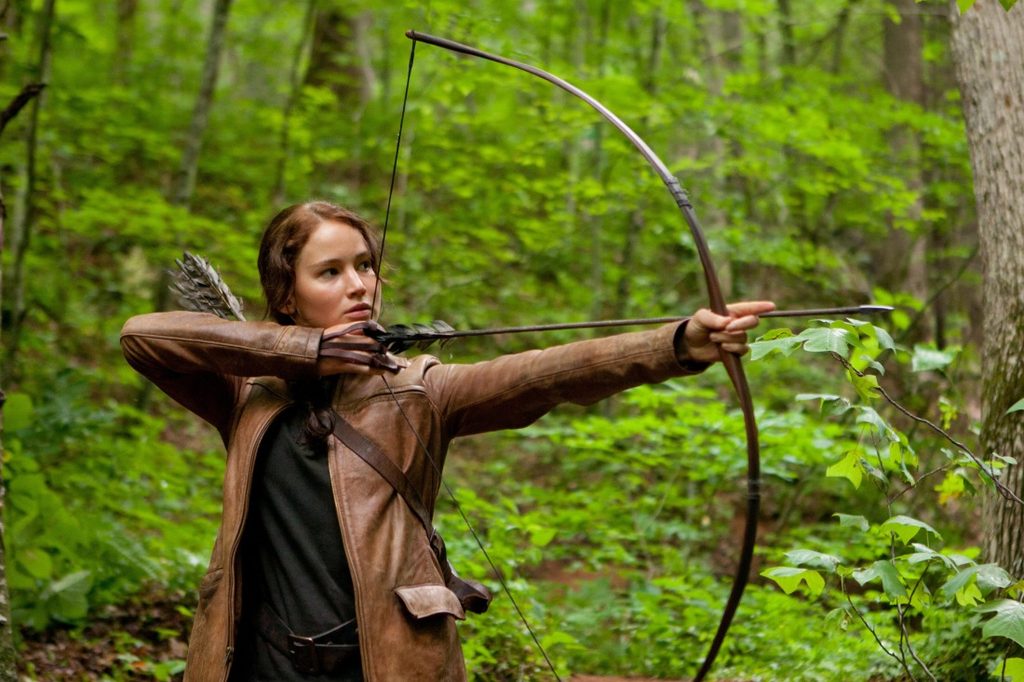
The success of Suzanne Collins’ saga is largely due to the quality of the narrative arc , which makes it almost impossible for the reader to put the book down once they’ve started. We’ve broken down the plot of the first volume to analyze the storytelling (be warned, this analysis contains spoilers).
The history exhibition
Katniss Everdeen, a sixteen-year-old girl, lives in Panem, in a post-apocalyptic America. The Capitol, Panem’s repressive government, organizes an annual televised event called the Hunger Games, which consists of choosing two teenagers from each of the 12 Districts and forcing them to fight to the death. The story begins on the day the tributes are chosen for District 12, where Katniss lives.
The trigger for the plot
Katniss’s 12-year-old sister is chosen to participate in the Hunger Games and represent District 12. Katniss volunteers to take her place to save her from certain death.
The twists and turns of the story
Katniss leaves District 12 with Peeta to participate in the Hunger Games. She faces the other tributes in the arena, and her relationship with Peeta experiences ups and downs. She manages to survive thanks to her courage and alliances.
The high point of history
Katniss and Peeta become the two surviving tributes of the Hunger Games by killing Cato, but the judges inform them that there can ultimately only be one victor. Katniss then threatens to commit suicide with Peeta, so that there will be no winner. The judges relent and declare them both victors.
The decline of narrative action
Peeta and Katniss leave the arena and are treated, but President Snow, who does not appreciate Katniss’s blackmail of suicide against the Judges, wants to attack Katniss’s loved ones, whom he considers a rebel.
The resolution of the plot
During the victors’ interview, Katniss uses her relationship with Peeta to justify her suicide threats, stating that she couldn’t live without him. This puts an end to the rumors of rebellion against her and saves her family.
The resolution of the plot
Katniss and Peeta return to District 12 as victors.
What is the difference between a narrative arc and a character narrative arc?
The narrative arc allows the various plot episodes to be placed at the right time, ensuring a logical and dynamic flow to the story. These events have repercussions for all the characters in the novel , both heroes and antagonists. The character narrative arc , on the other hand, focuses on the journey of a particular hero, revealing what leads them to pursue their quest and overcome all these trials , and the influence these trials have on their personal development .
The character’s motivations: desire and need
After the story is established, to begin their quest, the character must have a motivation , often something they desire . The goal of the character arc is to make the hero realize , as events unfold, that what they desire doesn’t necessarily correspond to what they need , and instead to lead them toward an unexpected resolution that turns out to be beneficial . A prime example is Andrea , the main character in Lauren Weisberger’s *The Devil Wears Prada* , whose dream is to work for a major New York magazine, but who encounters a series of problems after being hired as an assistant to the tyrannical Miranda Priestly, editor of the prestigious fashion magazine * Runway* (note: if you haven’t read the end of the book or seen the end of the film, skip to the next paragraph). This job takes her away from her best friend, her boyfriend, and her family, yet she does everything she can to fit into this world so different from her own and eventually earns the much-desired approval of her boss. Finally, she leaves her position at the end of the novel to find a new one that aligns with her need for meaningful work , rather than her desire for Miranda’s approval .
The character’s lie
The discrepancies between a character’s desires and needs lie in the lie they believe , and this lie is problematic because it prevents them from evolving . For example, in an adventure novel, the hero might initially believe themselves incapable of courage and aspire to a comfortable life, from which events will tear them away. In a romance novel, the protagonists might consider themselves unworthy of love and seek solitude, but the plot will ultimately lead them to a fulfilling relationship. The narrative arc must allow the characters to overcome this lie and accept the truth , breaking free from this cycle and guiding them toward a different future.
The character’s spectrum
The specter is the shadow of the character’s past, still influencing them as the story begins. Their wounds are what lead them to believe lies, prevent them from moving forward, and drive them toward their desires rather than their needs. Writing a compelling backstory for your characters is an important step that can help any work get off to a good start. Readers must be able to understand their problems , their motivations , and empathize with them.
As you’ve probably gathered, good writing and great ideas aren’t enough, because a story can’t stand without a well-developed narrative arc and character arc . To perfect the plot structure of your novel , you can entrust it to our Proofreading Workshop . An editor will annotate your manuscript and send you a personalized analysis examining, among other things, the characters, the narrative structure, and the plot, ensuring your story has a solid framework to build upon!